Maligakanda Courtroom Meltdown: How the Prosecution Bungled Witness Examination and Left the Bench Utterly Confounded
Special Legal Correspondent | Media Release Adaptation | International Investigative & Courtroom Journalism Standard
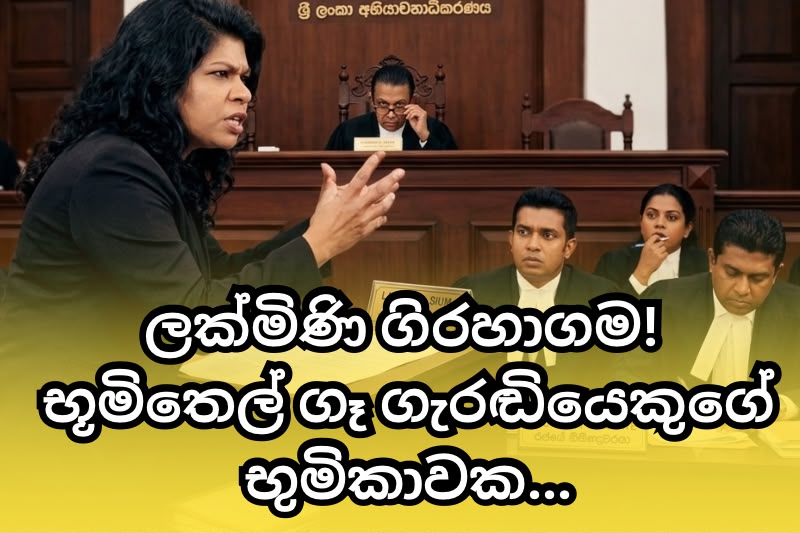
The Maligakanda Magistrate’s Court transformed into a theatrical stage last week, delivering a high-stakes blend of legal drama and sensational courtroom comedy. Additional Solicitor General (ASG) Lakmini Girihagama, representing the Attorney General’s Department, completely botched the examination-in-chief of Chief Storekeeper Nandana Bandara. In an aggressive bid to extract a pre-fabricated narrative, the prosecution succeeded only in leaving the witness, the courtroom, and ultimately herself, in a state of utter bewilderment.
From disrupting defense objections with unwarranted outbursts to attempting to force leading responses into the witness’s mouth, the prosecution’s strategy unraveled spectacularly. The proceedings reached such an absurd climax that the presiding magistrate was repeatedly forced to intervene, managing the state prosecutor akin to a patient kindergarten teacher guiding an unruly toddler back to order.
Venturing into Uncharted Waters: The Procurement Blunder
ASG Girihagama initiated her examination with a fundamental structural error—grilling the Chief Storekeeper on the intricacies of the state procurement process. Legally and operationally, this was a massive misstep, as the witness had absolutely no alignment or involvement with the procurement division. Sensing blood in the water, Defense Counsel Nayantha Wijeyasundera, representing the eighth accused, raised a vehement objection.
“How can you question this witness regarding procurement?” Wijeyasundera argued before the bench. “This witness possesses zero operational knowledge of procurement parameters. If the prosecution genuinely required clarity on this matter, the appropriate authority to examine was the former Additional Secretary of the Ministry’s Procurement Division, Mr. Nawawi, who testified previously. Grilling a Chief Storekeeper on matters he never handled is entirely inadmissible.”
Undeterred by standard trial procedure, the ASG persisted. She presented a series of documents compiled by the Government Analyst and the Questioned Documents Examiner (EQD), flatly utilizing leading questions to spoon-feed answers to the witness. Pointing directly at the files, she demanded to know, “These are Medical Supplies Division (MSD) stocks, aren’t they?”
This immediately triggered a secondary wave of objections from the Counsel representing the ninth accused. “The prosecution must first present the document to the witness for formal identification,” the defense noted. “This document was authored exclusively by the Government Analyst. The ASG must establish whether the Chief Storekeeper is even aware of its existence before interrogating him on its contents. Allowing the witness to merely read aloud text from an unfamiliar paper cannot be entered into the record as substantive, credible evidence.”
The Judicial Breaking Point: “Data Handled in Your Head”
Faced with a barrage of legally sound objections from Defense Counsels Nayantha Wijeyasundera, Rahul, and Amitha, Magistrate Priyantha Liyanage officially sustained the defense’s position. Turning directly to the witness box, the Magistrate interrogated, “Have you ever, at any point in your career, been directly involved in the state procurement process?” The Chief Storekeeper responded transparently, “No, Your Honor, I have never been involved. I functioned strictly as the Chief Storekeeper.”
Rather than conceding the point and shifting her line of questioning, ASG Girihagama embarked on a combative argument with the bench, attempting to justify her interrogation by claiming the witness was ‘generally aware’ of the facts. This pushback pushed the Magistrate’s patience to its absolute limit. Delivering a devastating judicial rebuke, Magistrate Liyanage addressed the state prosecutor directly:
“You have combined both the data in your head, but that is not the case. This is an arbitrary narrative you have constructed within your own mind, but it does not reflect the reality of the evidence. Do not pose questions in this manner!”
When the ASG stubbornly continued to bicker with the bench, the Magistrate firmly clamped down, putting an end to the procedural circus: “Stop it immediately. That is quite enough. Do not ask these questions. You are strictly barred from examining this witness on procurement. You may question him on stock management—an area where he holds direct, firsthand knowledge.”
The Cabinet Paper Debacle and “My Way” Jurisprudence
The operational comedy deepened when the prosecution attempted to navigate a critical Cabinet Paper attachment. The defense has consistently maintained that a drug shortage was artificially simulated to bypass standard regulations. Under questioning, the witness admitted that during the peak of the crisis, he was instructed to calculate stock balances that had fallen below a one-month supply threshold.
“I pulled the metrics directly from the system and compiled the attachment,” the witness stated. “I then handed it to the Acting Director of the MSD, Dr. Chandana Wijesinghe, who subsequently presented it at the high-level meeting attended by the Minister. The data I extracted was 1000% accurate based on the live system balances at that specific timestamp.”
Remarkably, even though the comprehensive Cabinet Paper file had already been formally marked into the court record, ASG Girihagama insisted on marking this specific attachment as an independent piece of evidence. Defense Counsel Nayantha Wijeyasundera requested a legal clarification, pointing out that a Cabinet Paper enters the record as a unified, holistic file—containing its English, Sinhala, and Tamil translations alongside all relevant annexures. “Marking a document piecemeal is procedurally bizarre. Is the prosecution implying that un-marked translation blocks are not part of the same file?” the defense asked.
Flipping standard evidentiary protocol on its head, the ASG defiantly shot back, “No, that is not the case! I will mark this document exactly the way I want to.” Noting her obstinacy, the Magistrate subtly shook his head and relented just to maintain progress, remarking wearily, “Fine, mark it your way for now. We will evaluate its legal weight and integrity at a later stage.”
Fabricated Purchase Orders and the “Slum-Style” Meltdown
The defense subsequently exposed a glaring attempt by the prosecution to mislead the court regarding pending supply queues. The ASG asserted that two separate purchase orders had been formally placed simultaneously through both the State Pharmaceuticals Corporation (SPC) and the MSD, implying a malicious duplication of procurement. However, Defense Counsel Asela Serasinghe, representing the second accused, completely demolished this theory by producing the prosecution’s own source files.
Serasinghe demonstrated to the bench that the SPC had never issued a formal, binding Purchase Order to any supplier. At that juncture, the SPC was trapped in severe logistical gridlock, struggling extensively to open a Letter of Credit (LC). Because the medication was of critical, life-saving necessity, the MSD stepped in to independently place an emergency order. The SPC file was merely an unexecuted administrative reference list sent for coordination.
“My learned friend driving this prosecution is doing this knowingly, which is the most shocking and alarming aspect of this trial,” Counsel Asela Serasinghe declared passionately to the court. “She is fully aware that no dual purchase order went to a supplier. You cannot deliberately distort material facts to unjustly jeopardize human lives and liberty.”
When Counsel Serasinghe commenced his cross-examination using the exact documentation the prosecution had entered into evidence, ASG Girihagama launched into an aggressive, disruptive tirade, shouting down the defense to block the witness from answering. The display grew so unprofessionally chaotic—resembling a volatile, unrefined street shouting match—that Magistrate Liyanage lost his temper. He sternly ordered the Chief Storekeeper to vacate the courtroom entirely and wait outside.
Once the witness was removed, the Magistrate addressed the screaming prosecutor, pointing out that she was caught red-handed objecting to her own marked evidence. “The text is written clearly in black and white on this document,” the Magistrate ruled firmly. “The witness possesses direct personal knowledge of these entries. Sit down and let the witness answer the question.”
Selective Justice Laid Bare
When Counsel Asoka Serasinghe, representing the fourth and fifth accused, took over cross-examination, a damning indictment of the integrity of the Attorney General’s Department was laid bare. The overarching criminal case centers on the emergency procurement of two primary drugs: Human Immunoglobulin and Rituximab (a highly specialized cancer medication).
Under cross-examination, the Chief Storekeeper admitted that Rituximab was vastly more expensive, involving significantly larger allocations of public funds. Counsel Serasinghe then queried the witness on corporate hierarchy. The witness confirmed that the fifth accused, Sujith Vasanta Kumara, was a lower-tier storekeeper handling Immunoglobulin, working directly under Assistant Director Ms. Solomon. Both were currently seated in the dock as accused parties.
The defense then delivered the coup de grâce:
“Who was the storekeeper responsible for handling the multi-million rupee Rituximab procurement?” The witness replied, “That was handled by Mr. Kasturisinghe.” “Is he present here in the dock?” “No, Your Honor.” “And who was the Assistant Director overseeing him?” “That was Ms. Wanniarachchi.” “Is she named as an accused in this courtroom?” “No, Your Honor, she is not here.”
The revelation exposed a glaring, politically convenient “selective approach” adopted by the state prosecution. The lower-tier handlers of the cheaper drug were aggressively prosecuted, while the high-value handlers of the far more expensive cancer drug were completely insulated from indictment. When asked if he knew the reason behind this blatant double standard, the witness softly replied, “I do not know, Your Honor.”
Furthermore, the witness conceded that the state’s ‘Pronto’ electronic inventory management system is notorious for lagging, often remaining un-updated for six to seven months, and occasionally displaying unfulfilled ‘pending’ orders dating back to 2015. He confirmed that an accurate assessment of state stocks is impossible without auditing individual physical files—a step the AG’s Department conveniently bypassed to rely solely on an isolated, system-based Government Analyst report.
The Ultimate Verdict: Flawed System or Supplier Fraud?
The definitive turning point of the day’s proceedings arrived when Counsel Asela Serasinghe established the broader context of the emergency procurement framework. The witness confirmed to the court that approximately 182 distinct categories of pharmaceuticals were imported during this crisis period using the exact same emergency regulatory channel. Out of all 182 drugs, catastrophic failures and material anomalies were detected in only two specific instances.
This critical admission effectively decoupled the entire trial from the state’s grand narrative of institutional conspiracy and systemic corruption within the newly introduced emergency framework. If the framework itself was fundamentally corrupt or conspiratorial, failures would have run rampant across all 182 lines. Instead, the evidence pointed squarely to an isolated instance of severe commercial fraud executed by a specific, unscrupulous supplier who manipulated the tender parameters.
By the end of the day, the prosecution’s chaotic handling of the trial succeeded only in alienating the bench and confusing the entire courtroom, leaving her own witness repeatedly pleading, “Your Honor, please instruct the prosecutor to repeat the question.” Attempting to replace cold legal facts with emotional, self-constructed illusions, ASG Lakmini Girihagama left the Maligakanda Court with a severely bruised ego and a mandatory, highly public set of ‘baby-sitting’ lessons delivered by a profoundly exasperated magistrate.