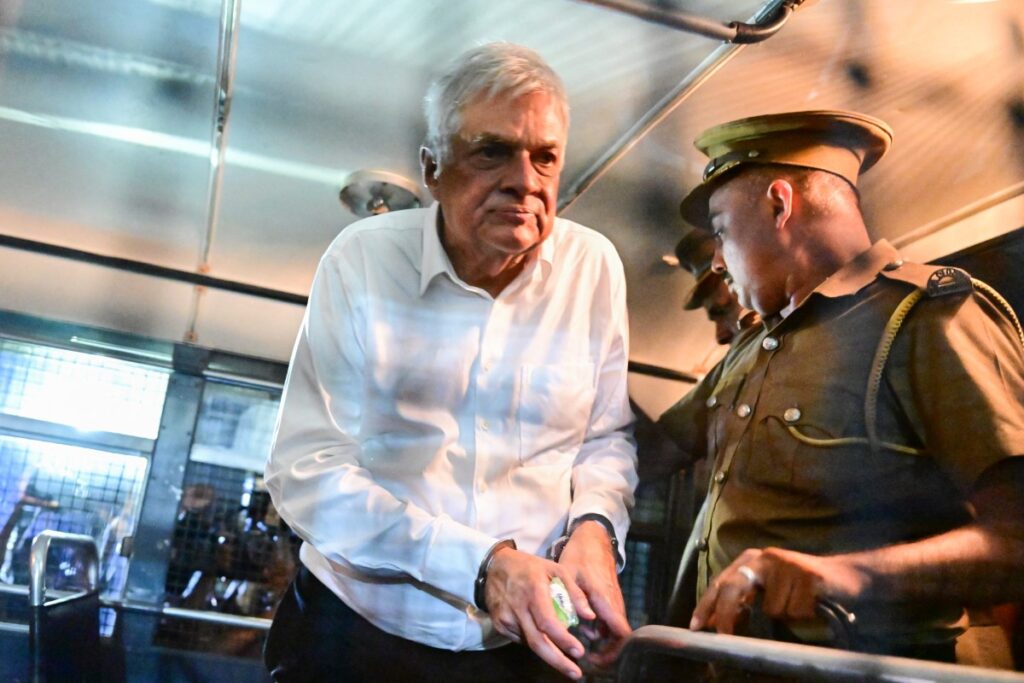
The arrest of former President Ranil Wickremesinghe last week over allegations that he misused state funds during a private visit to the United Kingdom has sent shockwaves through Sri Lanka’s political landscape.
As details surrounding the investigation emerge, a growing number of political analysts and legal experts are questioning whether the case is less about accountability and more about political vengeance.
At the heart of the controversy is a report compiled by K.N.M. Kumarasinghe, Additional Secretary to the President in charge of Anti-Corruption and Special Investigations. Kumarasinghe, a former Director at the Anti-Corruption Secretariat during the Yahapalana government in 2015, was appointed to his current position in October 2024, shortly after President Anura Kumara Dissanayake — a leftist firebrand long critical of Wickremesinghe’s liberal economic policies — assumed office.
The report, submitted to Presidential Secretary Sanath Kumanayake and forwarded to the Criminal Investigation Department (CID) on May 23, 2025, alleges that Wickremesinghe misused public funds allocated for presidential travel during a personal trip to the UK. The CID, acting on the report, began calling witnesses and recording statements, including from A.J.L. Wimalarathne, Director of Anti-Corruption & Special Investigations, according to the B-report dated August 22.
But legal observers point to a glaring absence of red flags in official financial oversight channels. Neither the internal audit mechanisms of the Presidential Secretariat nor the Auditor General’s 2023 report — publicly available and tabled before the Committee on Public Accounts (COPA) — flagged any irregularities. The Auditor General gave a clean certificate for all presidential expenses during Wickremesinghe’s term.
“This is unprecedented,” said a senior legal consultant familiar with the matter, speaking on condition of anonymity due to the case’s sensitivity. “If this were truly a financial misconduct issue, the National Audit Act of 2018, ironically introduced by Wickremesinghe himself, lays out a clear process. First, a surcharge inquiry. Then, if necessary, CID involvement. That protocol has been completely ignored.”
Indeed, Section 19 of the National Audit Act outlines the procedure for handling potential financial misconduct: the responsible official must first inform the individual of the alleged overpayment and provide a chance to repay. Failing that, the case should be referred to the Auditor General — an independent commission. Only after these steps are exhausted should a criminal inquiry be considered.
In Wickremesinghe’s case, these two initial steps were reportedly skipped. Instead, the Presidential Secretariat went directly to the CID — a move that critics say smacks of political calculus rather than administrative necessity.
“There’s no precedent for this kind of escalation, especially given that providing for the President’s transport, security, and logistics — whether the visit is official or private — is standard protocol. Every president has had such arrangements made for them. Why is this the one case being prosecuted?” asked a former senior official at the Presidential Secretariat.
For critics of the Dissanayake administration, the answer is clear. This is not a genuine anti-corruption effort, but a targeted political maneuver designed to discredit a rival who remains an influential figure in Sri Lankan politics. Wickremesinghe, who has long dominated center-right politics in the country, handed over the reins of power after the 2024 elections but retained significant support both domestically and internationally.
Supporters of the former president note that Kumarasinghe’s ties to earlier anti-corruption efforts under the Yahapalana coalition, combined with his rapid elevation under the Dissanayake government, raise questions about the independence of the investigation.
The government, for its part, has denied any political interference in the case. Officials have said that all investigations are proceeding “according to due process,” and insist that no individual is above the law, including former presidents.
But in Sri Lanka, a nation with a long and fraught history of politicized prosecutions, such assurances are unlikely to quell suspicion.
The coming weeks will test the country’s democratic institutions as the legal case against former president Wickremesinghe unfolds.
Whether this moment will be remembered as a landmark in Sri Lanka’s fight against corruption or as a warning of creeping political retribution, remains to be seen.